Tuesday, 14 June 2016

The NDP are just flat wrong on decriminalization

Do you want organized crime ? Because that's how you get organized crime...

I don’t necessarily think that the Liberal move to legalize and regulate marijuana will go well. With that said, I do think it will go a lot better than any move to decriminalize marijuana. Unlike most ambiguous questions around the legalization of soft drugs, there is some evidence to attest to decriminalization’s poor record. I am of course talking about the world’s foremost marijuana mecca, Amsterdam. 

To give a brief positive view, the Dutch policies have done a lot to reduce drug use among addicts, reduce soft drug use by youth, and have proved true a lot of the other harm reduction principles purported by supporters of both legalization and decriminalization. That’s about where the good ends. Turning Amsterdam into the number one destination for global stoners and European stag parties is a move that surprisingly is not appreciated by the majority of residents. After all Amsterdam is home to the Van Gogh museum, the Anne Frank house, and countless other austere cultural landmarks - but that’s not what most people think of. This is …
Image result for dutch coffee shop
(A very subtle fan of Dutch Cannabis)


I can see why this rather dim view of a diverse cultural region might annoy some. I grew up in Nova Scotia after all and we have a similar situation.

(A Proud piece of N.S. Culture)
So the tourism benefits are at best a mixed bag, and would probably annoy the crap out of anyone who was a resident of the area effected. 

Now we get to the straight up bad. The Dutch laws when they were written in 1976 attempted to decriminalize personal soft drug use, while keeping traffickers out of the equation. Through a variety of loopholes, and eventual tolerance through public support, the coffee shop evolved out of these polices. Now this is where stuff gets really weird. The laws strictly forbid large-scale production. People are only allowed to buy 5g at a time, and can technically only carry 5g. Coffee shops themselves are only allowed to keep a stock of 500g of product. Now if we ignore the fact that anyone transporting the 500g a coffee shop needs is already breaking the law, how do the shops restock, because 500g of product at 5g a sale will last 100 transactions. I can tell you from experience that most shops serve far  more than 100 customers a day.  What am i hinting at here? Well because the laws are only designed to protect the individual and don’t really facilitate large scale production and sale, there is an awful lot of cannabis production that occurs on the grey market. This is produced in mostly unregulated illegal ways, then put into legitimate businesses that plead the 5th on where they got it and continue to sell it unabated. Here’s a quote from the website of one of Amsterdam’s premier seed producers:

So if I didn’t explain it well enough, there it is from the horses mouth. Having a system where personal possession is decriminalized means people will demand somewhere to buy and consume the product they are personally entitled to use. 

This is what has been happening on the West coast, where simple possession has been de-facto decriminalized with various municipalities refusing to prosecute personal amounts. Coffee shops have quickly flooded in, and medical retailers are offering Skype sessions with a nurse where you can get a medical card in about three hours.  Since Canada’s dedicated medical suppliers can’t possibly be filling the west coast demand this means that there is very likely a lot of grey market growing going on. Vancouver and Toronto have begun to crack down and regulate this budding industry (Victoria has as well to a lesser extent), but the flood gate have opened and people are unwilling to comply. In the case of Amsterdam it took a while for the grey market to evolve, it was after all 1976 that their laws were changed,and ideas took a little longer to spread then. However, today  the Dutch marijuana business is by best estimates selling 265,000 kg of marijuana and its byproducts with an annual gross revenue of about $3.2 billion USD. Not only that but they are able to pass on all the experience they gained building up this hidden industry to anyone who has an internet connection. 

This is why the NDP is flat out wrong on its suggestion that the Liberals should decriminalize marijuana ahead of next March’s announced release of marijuana legislation. This will lead to a possible last hold for organized crime groups, and may give them the fuel they need to legitimize their businesses when full legalization comes. If it’s anything like Amsterdam it will also lead to a massive spike in production of hard drugs by these organized crimes groups, looking to diversify their interests. This is exactly the thing that the move to full legalization is trying to combat. 

Uruguay, a country who interestingly never actually  criminalized marijuana, tried to shut out drug producers by regulating government pot shops, that set the price at half of the black market average. This move undercut the black market so much that many experts speculate illegal cannabis production has all but ceased in the country. All thanks to the market, not heavy handed enforcement. 

Whats the summation here? Back off NDP, unless you want to help create the next great crime syndicate, the Liberals actually seem to be navigating this as best they can. Let’s not turn Canada into one big Amsterdam.

Friday, 10 June 2016

The NDP doesn’t need a new leader...

They need a new party


The NDP is currently going through one of the least controversial leadership races in Canadian political history. So far Tom Mulcair has been booted from the incumbent job giving him little choice but to hang up his orange leader hat, or face an embarrassing defeat at the convention.  So far several popular NDP MPs have made announcements regarding their leadership bid. 

Former deputy leader, and recent landslide election loser Megan Leslie has said she won’t enter the race and she was arguably the NDP MP with the most experience. Leslie’s seat even had NDP prestige being held by former leader Alexa McDonah for more than a decade. Nathan Cullen, a popular name in party circles has ruled himself out, Ontario MP Cheri DiNovo recently held a press conference announcing she would not run because she didn’t have the money (the press conference was presumably free to organize, plan, and hold). 

(The Greatest Canadian poll is rated as one of CBC's most accurate)
Why is no one scrambling for the top job? Is the NDP still a party that’s worth running? This was after all, the first Canadian political party to put a woman at the Helm. The NDP were the party that brought public healthcare to Canadians. I mean the greatest Canadian ever, Tommy Douglas, was an NDP man (according to a 2004 CBC poll). So why, in 2016, does no one want the job anymore?

If I were to take a guess, it may have to do with the fact that this isn’t the same NDP. For the last decade or so the NDP has been moving more and more to the centre, leaving their truly socialist roots behind them. Jack Layton, a personal hero and the best NDP leader of my lifetime, was just as guilty of centring the party as anyone else. After all it was under his leadership that the NDP seemed to badger the public with talk of a coalition with the Liberals just for a chance at unseating the Conservatives in 2009. Speaking of 2009 and the NDP “Orange Crush”, man predicted this to be the signal that the NDP was truly on the same level as the Liberals and Conservatives, but like a ballon that wasn’t tied they quickly deflated. After a few years of the rhetoric, and question periods where the NDP sounded more and more like the liberals every session, no one saw a strong ideological difference between the two left parties. Canadians seemed to finally understand that a vote for the third place party is sometimes a vote for the first place one (at least in a FPP system). The NDP in recent election have generated just as many action plans, potential budgets, attack ads and all the rest of the accoutrements as the other big parties. Jack, and the leaders before him realized they could do more by playing the same game. They forgot that what led to their slow rise in popularity was the fact they didn’t resemble the other parties. “Anyone but Harper” was probably the death of a successful NDP. When people ceased to vote for the NDP and started to vote against  the Conservatives, this means Canadians viewed the NDP as little more than and end to a means. 

If the NDP want to gain back some ground politically there is no easy solution. They have to do what Tommy, and Alexa and the other NDP pioneers did before them: slowly and steadily build up a left wing opposition that is both credible and sustainable. Now I know that’s not a snappy punchline, but it’s the truth. What established the NDP was not that they were seated to the left. It’s that they had progressive ideas, and the credible background to pull them off. At this point the NDP has a long road to rebuilding, and clawing back their position in Ottawa. 


There is a party in Canada that might be able to help them speed this up a little, even if they don't look overly happy about the prospect.
Image result for elizabeth may angry
(An unhappy MP May in the foreground -
 The Green Caucus pictured in the background)

Elizabeth May and the Green party have been so slowly building a base. The are honest to the point of looking stupid - for instance they didn't release a budget plan for last election as they admitted they had no resources to do it properly. This is compared to the NDP who spent the time and money generating a plan, that was equal parts crazy, and wishful, but was not by most analysts review based in reality. If the NDP wants to stand tall on the hill again, they are going to  need a backbone. In Canadian politics there are two ways to get an ideological backbone. One can either grow it themselves over a very long time and carefully made decisions, or you can do what the PC’s did in the 90’s, transplant a backbone thats more ideologically pure than you are. Uniting the right gave new life to Canadian conservatism. It’s time for the NDP caucus to provide their constituents a competent crew MP’s with an ideological backbone rooted in the left. Elizabeth May would make a great NDP whip, just saying. 

Tuesday, 7 June 2016

Why trains are killing Canadians


and why politicians aren’t allowed to stop them 

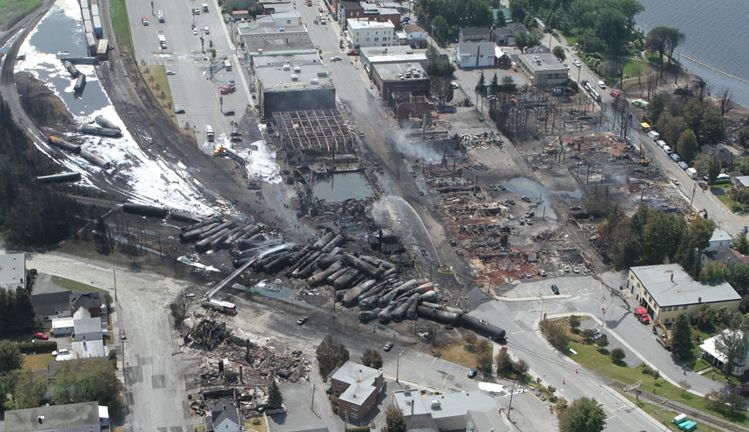
Image result for lac megantic
(Burning DOT-11A Tank Cars)

Marc Garneau announced this week that his government was going to start dealing with the issue of runaway trains. The issue he is referring to is the fact that during 2015 there were approximately 42 incidents of runaways, up from 30 incidents the previous year. While a few runaway rail cars drifting down the track doesn’t immediately strike fear in Canadians hearts, it really should. Here’s a couple visual aids to help explain why 
(A photograph that shows some
of the devastation)


      If these images don’t jog your memory let me remind you of the terrible tragedy that occurred. Approximately two years ago in July, an unattended freight train with 74 cars rolled down a 1.3% grade (not insignificant for a train as the max grade allowed is 2.2% in the US) causing many of the tanker cars to explode in the town of Lac Megantic, Quebec. The resulting disaster killed almost 50 people, and physically devastated the small Quebec town. 

After such a damaging tragedy, I should dam well hope Minister of Transport Garneau   would make stopping runaway trains a priority. After all as this article has already said incidents such as the one that caused the Laq Megantic disaster are on the rise. One of the other problems with the governments line of change, is with one of most daring, albeit mundane parts of the issue - the tanker cars themselves. 

The type of train car used for oil transport is Canada is overwhelming the DOT-111A Tank Car. Here’s a quote about the car’s safety features 


We can’t expect politicians to act immediately, after all the amount of infrastructure, cars, engines, track etc. that is needed to run a railroad is immense, and replacing such a large part of that infrastructure would be an insurmountable cost for any company. So when was this report, the one determining these cars have a much higher rate of failure than others available, released, i’ll take a sip of coffee and assume it’s recently and not that the Canadian government ignored such dire warnings for decades…
1994…

Image result for spit take
(This post is already getting pretty dark,
so i've tried to brighten it momentarily
with this photo)

Not only that, but 1994 represented the Canadian Transportation bureau bringing this to our politicians attention by citing and earlier American report from 1991.
So what the hell right ? Our politicians clearly know about this problem and have for more than 25 years, the issue is clearly getting worse, why is nothing being done? Who is tying our politicians hands on this issue ?

You are.
(The same "you" that made the cover of Time)

Canadian Politicians can say they want to fix the problem all they want, but the truth is they know, just as you soon will, that instituting the very solution to the problem of runaway rail equipment, would put any politician out of a job, ensuring they could never actually see the change through. 
So what is this magic solution ? Well if you’re about 60% of the population by my serviette-math (napkin -math for my non existent US readers) you might not like it. 
Pipelines. 

Now hold on a second, put down your pitchfork and give me a chance to make my case.

Canada moves quite a lot of oil, we are a rather large long country after all, and most of what we have (oil wise anyway, all the people reside in the middle) is on one side of the country. Because of current opposition to pipelines, we transport an alarming amount of that oil by rail. As i’ve already said, this is safety wise a pretty bad move, as far as efficiency goes, it doesn’t get much better. 
The basic process as you can imagine is taking a lot of this oil, confining it to a small tank, attaching that tank to a long string of other tanks, then pulling this with a giant locomotive across the country at an incline of no more than 2.2% - oh and occasionally the brakes on these locomotives don’t work, or are improperly locked causing tragic loss of life, a calamitous damage. Because of all this the rail is usually the last option for moving oil, but because of the political reality of pipelines that I mentioned earlier it has to be used in areas where safer infrastructure isn’t available. Rail transport in Canada moved the equivalent of 167 million barrels of oil in 2013, and about 1,307 Mboe (Million barrel of oil equivalent) from 2003-2013. During this period there was 296 accidents where oil spilled. Due to the nature of this mode of transport almost all of these incidents where spills occurred were outdoors. 

When you flip the coin, during the same period there were 1,226 pipeline incidents. While that number seems initially higher, the amount of oil transported by pipeline from 2003-2013 was a startling 24,909 Mboe. That means pipelines moved a little over 19 times the amount of oil as rail did. When you remember were talking about millions of barrels of oil here, this becomes pretty astounding. Now if you’re not already crunching the math, let me put it out there. This means per barrel oil transported by by pipeline there is a 0.049 % chance of a spill. By rail transport, of every barrel transported 0.227% or about one in five barrels leak. It is over 4.5 times more likely to have a spill if we move a barrel of oil by rail, rather than through a pipeline. This is not the end, because about 83% of pipeline spills do not occur “in pipe” or out in the wild where serious damage can occur. 83% of pipeline spills, happen in oil processing facilities where many safeguards are in place, and product does not make it to the environment. Compare this to rail, which as I already said transports most of its oil outdoors, and 75% of spills do occur directly in the environment with little to no safeguards.

These numbers and facts while startling, do not in any way compare to the images a Laq Megantic burning. Those images do their best to try to represent the true impact of transporting oil via rail, rather than the much, much, safer pipeline option.

No matter how much politicians like Marc Garneau say they will stop rail disasters from occurring, no matter how many safeguards are added, or dangerous tanker cars replaces, putting oil into little tanks and dragging it from one side of the country to another will always a terrible option. Politicians know this, but we, the public, with our heads so deep in the sand of bad environmentalism and pipeline hate, we have tied our representatives hands. 

Its time to wake up and do the one thing that will stop, the tragedies of transporting oil by rail, stop transporting oil by rail. 

note: most of the hard data from this report was taken from the Fraser institutite study linked here